The Technological Origins of Aggregate Fluctuations and Systematic Risk
Rory Mullen
Abstract: This paper provides a unified explanation for aggregate fluctuations and systematic risk in the cross-section of firms. Using data on U.S. public firms, I document that covariances between firms' growth rates drive most of the variance in aggregate productivity, sales, and profits. High-productivity firms contribute disproportionately to this covariance but relatively little per unit of market value. This pattern may explain why investors accept lower returns from these firms. I introduce a model where firms choose their exposure to technology-specific risks by diversifying across multiple business lines. The model matches key empirical patterns, generating endogenous firm-level and aggregate fluctuations, as well as cross-sectional differences in systematic risk. Regression analysis offers preliminary support for the model's predictions.
Figure: The Technology Choice Problem of Firm ω
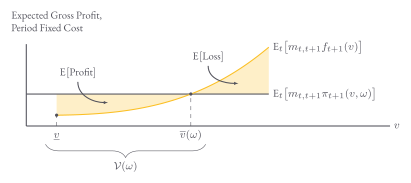
Notes. The figure illustrates the technology choice problem for firm ω. The vertical axis measures costs and benefits associated with firm ω's operation of different technologies. The horizontal axis represents the set of available technologies, arranged left to right from least to most expensive in terms of fixed costs. The horizontal expected discounted gross profit curve represents firm ω's expected benefit from operating the available technologies. The upward-sloping fixed cost curve represents the fixed cost associated with each technology. Firm ω's technology set is determined by the intersection of the expected gross profit curve and the fixed cost curve at point v̄(ω). The firm can profitably produce only with technologies to the left of this point.
BibTeX Citation
@unpublished{Mullen2025AggregateFluctuations,
        title={The Technological Origins of Aggregate Fluctuations and Systematic Risk},
        author={Rory Mullen},
        note={Working paper},
        year={2025}
}