Intermediate Finance
10-Week Undergraduate Course
Terms taught: Autumn 2020, Autumn 2021, Autumn 2022, Autumn 2023, Autumn 2024, Autumn 2025
Course Description: This undergraduate course focuses on portfolio theory, asset pricing, and derivatives. The first half introduces uncertainty and risk aversion before covering optimal portfolio construction, the Capital Asset Pricing Model, and market efficiency. The second half introduces arbitrage, then examines bond markets, yield curve arbitrage, forwards, futures, and options. Throughout the course, readings, problem sets, and interactive polls reinforce key concepts and help students develop practical skills. Students should be comfortable with algebra, calculus, and statistics.
Figure: Optimal Portfolio Selection with Risk and Return
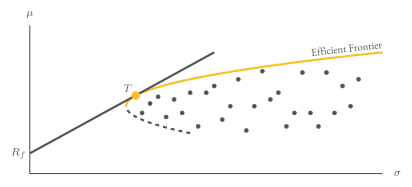
Notes. The figure illustrates the efficient frontier in portfolio theory, showing the trade-off between expected return and risk (standard deviation) for different portfolio combinations. The curved line represents the efficient frontier, where investors can achieve the highest expected return for a given level of risk. Individual assets are shown as points, and the tangency portfolio represents the optimal risky portfolio when combined with a risk-free asset. The region below the efficient frontier contains all feasible but suboptimal portfolio combinations.
Student Evaluations
| Year | Rating | Responses |
|---|---|---|
| 2025/26 | 4.8/5 | 31 |
| 2024/25 | 4.8/5 | 31 |
| 2023/24 | 4.8/5 | 49 |
| 2022/23 | 4.6/5 | 62 |
| 2021/22 | 4.6/5 | 61 |
| 2020/21 | 4.4/5 | 111 |
Rating is the mean of the lecture items (“Lectures with Rory Mullen”) in the WBS module feedback, on a 1–5 scale; Responses is the number of students who completed the feedback.